• Following Us

  • Categories

  • Check out the Archives


  • Awards & Nominations

Millennium – Weeds (Review)

This February and March, we’re taking a trip back in time to review the fourth season of The X-Files and the first season of Millennium.

Weeds concludes the loose “suburban trilogy” running through the first season of Millennium. In fact, Weeds was filmed directly after Wide Open, but was pushed back in the broadcast schedule so as to air after The Wild and the Innocent. While this change in broadcast and production order is nowhere near as confusing as the scheduling hijinx happening with The X-Files at the same time, it does give an indication that the production team recognised the potential similarities between Weeds and Wide Open.

Both episodes are about the violation of a supposedly “safe” space, bypassing and subverting all the potential security put in place to keep the home secure. In Wide Open, the killer visits open houses and hides in wardrobes until the family go to sleep that night; in doing so, he avoids setting off any alarms. In Weeds, a secure and gated community discovers that they cannot keep their children safe; someone within the community is preying on the residents’ children. As with The Well-Worn Lock, there is a sense that families are not safe, even when they think that they are.

Community watch...

Community watch…

As with Wide Open, Weeds feels just a little bit sensationalist. It is the kind of episode that attracts criticisms about gratuitous violence or exploitation. Millennium was never quite as excessive or as sadomasochistic as its critics would suggest, but there are definite tendencies towards those extremes on display at certain points in the run. While Millennium is very clearly driven by a core moral philosophy, it can occasionally seem a little too comfortable with its brutality or depravity.

Indeed, Weeds hits on quite a few of the stock fears that run through the first season of Millennium: children are victimised by a person in a position of trust and authority; there is biblical quotation; there is sadistic (and disturbing) torture filmed in a heavily stylised manner. There is something almost cynical and calculated about how Weeds hits these familiar buttons; these impulses towards excess haunt the first season of Millennium, and are building to something of a catharsis in Loin Like a Hunting Flame.

There will be blood...

There will be blood…

Continue reading

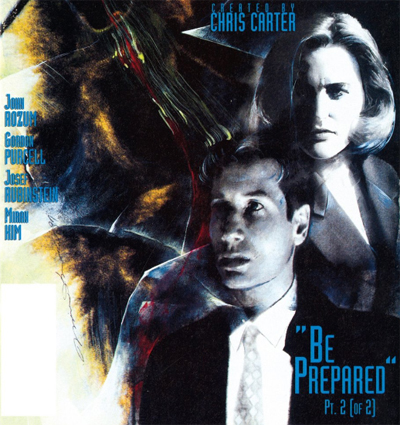
The X-Files (Topps) #25-26 – Be Prepared (Review)

This February and March, we’re taking a trip back in time to review the fourth season of The X-Files and the first season of Millennium.

What’s interesting about Be Prepared is how much it feels like an episode of The X-Files.

A lot Rozum’s earlier scripts felt like Mulder and Scully had wandered into old E.C. horror stories, cautionary supernatural tales about vengeful ghosts and poetic justice. In contrast, Be Prepared feels very much in tune with the aesthetic of the show itself. Mulder and Scully investigate a uniquely American piece of folklore, finding themselves in an isolated location dealing with human monstrosity at least as much as any paranormal element.

If you go down to the woods today...

If you go down to the woods today…

Indeed, Be Prepared feels very much like an episode from the first two seasons of the show, evoking stories like Ice or Darkness Falls or Firewalker. Indeed, Be Prepared arguably sits comfortably alongside Topps’ range of Season One comics – feeling like a lost episode from the show’s early years. Be Prepared feels like the first time that Rozum is constructing a story specifically from tropes associated with The X-Files, rather than from horror tropes in general.

The result is a fun little adventure that feels more like The X-Files than the comic has in quite a while.

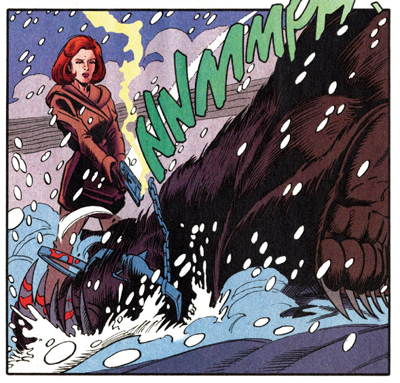
The right to bear arms...

The right to bear arms…

Continue reading

The X-Files – El Mundo Gira (Review)

This February and March, we’re taking a trip back in time to review the fourth season of The X-Files and the first season of Millennium.

The X-Files is a show that sometimes has difficulties when it comes to portraying minorities.

There are lots of episodes that offer insightful and thoughtful explorations of isolated subcultures, without veering into offensive stereotypes or awkward cliché. Fresh Bones and Hell Money are two examples of the kinds of stories that do offer those sorts of interesting and respectful depictions of minorities. In contrast, the show can sometimes seem a little close-minded and xenophobic. Excelsis Dei, Teso Dos Bichos and Teliko are episodes with somewhat questionable depictions of other cultures.

Illegal aliens.

Illegal aliens.

Writer John Shiban likes his horror tropes. He adores the classic horror movie trappings, and revels in a very old-school approach to scary stories. Unfortunately, the horror genre has an unfortunate history of exploitation and racism when it comes to the portrayal of “the other.” The easiest way to make something scary and unknown is to make it foreign, suggesting that the outside world is filled with horrors and monstrosities. Shiban would hit on this trashy exploitation vibe repeatedly during his tenure on The X-Files.

El Mundo Gira is very much a companion piece to Shiban’s other stories about foreign monsters – the indigenous cat-people of Teso Dos Bichos and the butt-dwelling Indian fakir of Badlaa. It is a not a story set in the world of Mexican-American immigrants; it is a story set in a clumsy stereotypical depiction of the world of Mexican-American immigrants, as channelled through unfortunate racial stereotypes.

Green haze...

Green haze…

Continue reading