












This May, to celebrate the release of X-Men: Days of Future Past, we’re taking a look at some classic and modern X-Men (and X-Men-related) comics. Check back daily for the latest review.
Wolverine/Gambit feels like a nineties comic in so many ways. Jeph Loeb’s narration consciously apes the popular style that Frank Miller brought to The Dark Knight Returns and Batman: Year One, among others. The focus on two characters within the X-Men mythos reflects the popularity of the brand during the decade, but the focus on Wolverine and Gambit also speaks to a very nineties enthusiasm for anti-heroes. Similarly, the comic transforms a relatively cartoonish bad guy into a misogynistic serial killer, complete with snippets of letters from Jack the Ripper to provide a suitable amount of pretension.
Wolverine/Gambit is a fairly dodgy comic book, one that embodies some of the worst trends in nineties comic books. Perhaps the most notable thing about Wolverine/Gambit: Victims is the fact that it provides an example of a relatively early collaboration between writer Jeph Loeb and Tim Sale.

Seeing eye-to-eye…
Jeph Loeb and Tim Sale work well together. Their first collaboration was at the start of the nineties on Challengers of the Unknown. The have written a number of high-profile works together, including the celebrated “colours” trilogy for Marvel – Spider-Man: Blue, Daredevil: Yellow and Hulk: Grey – and a trilogy of Batman books that feel steeped in the noir aesthetic – Haunted Knight, The Long Halloween and Dark Victory. When Jeph Loeb worked on the show Heroes, he recruited Sale to provide some beautiful artwork.
Wolverine/Gambit came a few years into their collaboration, conveniently located in the middle of their work on Batman. Wolverine/Gambit was first published between their Haunted Knight trilogy and their longer collaboration on The Long Halloween. As such, Wolverine/Gambit comes at a pivotal time for the two creators, at a point right when Jeph Loeb and Tim Sale were on the cusp of breaking out.
Dust to dust…
In many respects, while Haunted Knight is a wonderful collection of short stories, it is The Long Halloween that would really cement their relationship as one of the most compelling writer/artist teams of the nineties. The Long Halloween became an influential and foundational story for Batman, with Loeb and Sale providing significant inspiration for Christopher Nolan’s vision of the Caped Crusader, among others.
Wolverine/Gambit isn’t anywhere near as successful or influential. While Loeb and Sale play well enough off one another here, their work doesn’t feel as easy or as comfortable as it does on their strongest collaborations. Instead, Wolverine/Gambit is a story that works better than it should, with a sense that neither writer nor artist is being pushed too far outside their comfort zone. There’s very little about Wolverine/Gambit that demonstrates the strengths of their partnership.

Sink or swim…
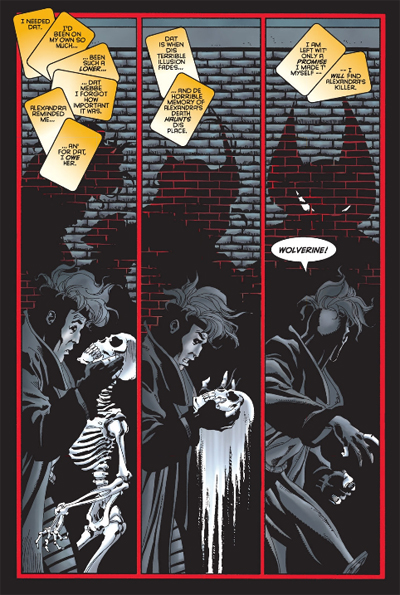
Indeed, Tim Sale’s art style here is a lot more conventional than it would become in the years ahead. While the artwork on Wolverine/Gambit isn’t generic by any stretch of the imagination, and is very recognisably the work of Tim Sale, it doesn’t feel as complete as the artist’s other work. Part of that is undoubtedly down to the method employed by Sale – this isn’t as elegant or as beautiful as the painted style he would bring to The Long Halloween – but Sale has also conceded that there wasn’t any “emotional involvement” in the story.
Jeph Loeb’s script for Wolverine/Gambit is decidedly more problematic. Wolverine and Gambit were phenomenally popular characters in a phenomenally popular franchise – it made sense for Marvel to try to leverage that success. Unfortunately, much of Wolverine/Gambit feels rather paint-by-numbers. There’s nothing quite as delicious as “let’s do Batman via The Godfather“ here. Instead, it’s a fairly stock nineties story, in a number of unfortunate ways.
Shocking…
Loeb decides to set the action in London, for some reason. This is a perfectly justifiable choice. It’s nice to get a bit of geographic diversity. Tim Sale is an artist who works very well capturing more old-world environments. His Gotham certainly looks almost classical. Sale draws Europe very well, and it’s certainly a break from New York. The problem is that Loeb tries to write specifically to the location, in a number of ways that feel unfortunate.
For example, Loeb is fixated on the idea of guns. British police officers do not generally carry firearms. However, Wolverine/Gambit: Victims decides to seize on this as an error in judgement. When a police officer is killed in the line of duty, her father laments, “They still don’t carry guns, y’know. Imagine in this day and age, and the police still don’t carry guns.” It is not presented as a matter of pride or a carefully weighed decision, but as a short-sighted failing.
Smoke ’em if you got ’em…
When we meet Martinique Jason, the primary female guest star, one the first things that Loeb does to demonstrate that she is a character worthy of our attention is to have Gambit remark on her weapon skills. “Knows how to use a gun,” Gambit observes, shortly before our three heroes cause a bus crash at Picadilly Square to aid their escape from the authorities. There’s never any suggestion that waving guns and causing bus crashes around London might be pretty bad behaviour. It’s just treated as the norm, with Wolverine/Gambit treating London as something relatively quaint and almost backwards.
The decision to base the plot around Jack the Ripper doesn’t help matters much. It immediately establishes the comic as rooted in a very nineties aesthetic. Violent serial killers became more popular in the comics of the decade, as did violence against women. Here, the cartoonish super villain Arcade is presented as a predatory serial killer who preys on young women. It almost reads as a parody of the tendency towards “darker and edgier” in the comics of the decade.
A cutting retort…
However, Wolverine/Gambit is predictably flippant about the victims of this serial killer. Gambit heads to London to investigate, and we get a scene or two of him angrily complaining about the murders while reviewing the case and interviewing families, but it amounts to very little. The plot focus of Wolverine/Gambit is very much centred on our lead characters. When Gambit is led to believe that Wolverine may be a psychopathic serial killer who killed an old friend and a new ally, he gets a little upset about it (“why’d ya do it, Logan?”) but immediately goes back to working with his team mate as if nothing is wrong.
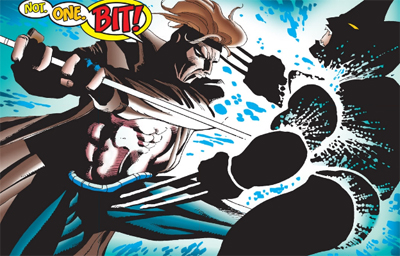
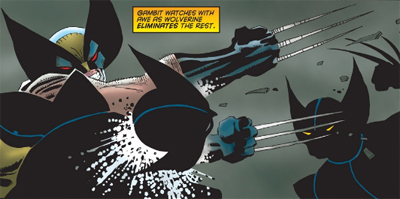
It all feels very rote, very generic, very casual. There’s no depth to any of this. Jeph Loeb quotes from the popular Ripper letters in order to try to add a bit of “British flavour” to the story, but it just feels too obvious. There’s a violent criminal in England. Of course it has to be a serial killer, modelled on Jack the Ripper. Similarly, there’s very little of real depth in Wolverine/Gambit, as things happen in order to facilitate the demands of this sort of crossover, including the inevitable “two heroes fight” sequence.

Playing his cards right…
It is interesting that Wolverine barely features here. Much of Wolverine/Gambit is told from the perspective of Gambit, with Wolverine serving as a patsy in the sinister mind games being run by the villain Arcade. Gambit travels to London and encounters Wolverine there, and Gambit is the character with the personal stake in the murders, while Wolverine seems to have just got caught up by chance. Loeb invites us more readily into Gambit’s head than that of Wolverine.
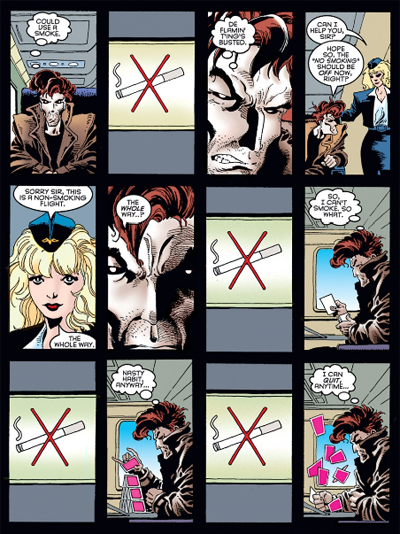
Both characters had, of course, headlined their own individual miniseries beforehand. Both characters would also hold down their own monthly series afterwards. Loeb doesn’t really offer too much insight into either. Outside of an endearing gag about Gambit’s tobacco addiction, the most surprising revelation is that Gambit’s internal monologue has a Cajun accent. “Dere are few things dat excite me as much,” he reflects at the start of one issue. There are few things as ridiculous as Gambit’s accent.

A bloody mess…
Loeb falls into the somewhat stock portrayal of Gambit as a thief with a heart of gold. When he is arrested stealing a priceless work of art, he has a perfectly valid excuse. “De painting I… acquired dis evening. It was stolen from a Frenchman by de Nazis during de war. It ‘as changed hands several times since den — but, after tonight, it would ‘ave been returned to its rightful owner.” The comic makes it clear that he was betrayed by a thief with far fewer scruples.
Wolverine/Gambit is sadly but a footnote for all involved, serving as neither a high point in the publication history of its characters, nor the bibliographies of its creators. It is a very nineties production, for better or for worse… mostly worse, unfortunately.
Filed under: Comics |



 the m0vie blog
Oh hey, Jeph Loeb wrote a comic badly? You don’t say.
Ha!
I’m more sympathetic to Loeb than most (hey! I like Hush as an archetypal Batman story!), but you’re right; his batting average is… not great.